

Most Cases are Reduced or Dismissed: We are proud of our record with our clients. You deserve an attorney who can help prevent you from acquiring a criminal record.

OWI Felony Wisconsin
Under Wisconsin law, most first and second OWIs (Operating While Intoxicated), as well as some third offenses, are treated as misdemeanors. However, there are several circumstances under which prosecutors may try to treat an OWI as a felony. These include a number of factors, ranging from specifics of the incident itself to previous offenses on your record. A few situations in which a misdemeanor can be elevated or even treated as a felony are as follows:
Accident Causing Injury or Death
Let’s say you have a few glasses of wine after dinner and decide to drive home. On the way, you drift across the centerline and accidentally hit another car head on. Checking on the other driver, you see that they have broken their arm in the crash. At this point, at the very least you will likely receive OWI Causing Injury, which is considered a Class H Felony (particularly if this is not your first OWI). If the other driver’s injury is more severe, consisting of permanent damage like brain injuries or disfigurement, those charges could be elevated to OWI Causing Great Bodily Harm, a class C felony. And if the other driver was killed in the accident, you could now be charged with Homicide by Intoxicated Use of a Vehicle, which carries 40 years in prison as a class C felony.
 Having a Child Under 16 in the Vehicle
Jack brought his 12-year-old son to a baseball game, and had several beers in the course of nine short innings. On his way home, a police officer noticed him swerving across the centerline and initiated a traffic stop. Jack was found to have a Blood Alcohol Content of .08, triggering a charge of OWI. Because his child was in the back seat and was exposed to the dangers of his drunk driving, Jack faced fines double what he would have paid otherwise, along with more jail time and a longer revocation of his driver’s license.
Having a BAC of .15% or Higher
After leaving a house party where he had multiple shots of liquor and several beers, Hugh chose to drive home even though he had a previous OWI conviction on his record. Getting pulled over a few blocks from the party, he is found to have a BAC of .19%. That excessively high level of intoxication triggered further penalties including extended license suspension and installation of an ignition interlock device (IID).
Driving on a Revoked or Suspended License
Dusty was on month five of a six-month license suspension following a previous OWI arrest. Figuring he wouldn’t get caught, he drives home from the bar after enjoying a few beers. Unfortunately for Dusty, a police officer saw him swerving and pulled him over, testing his BAC and finding it at .08%. Because he was driving with a suspended license, Dusty was charged with a felony.
Refusing a Chemical Test with Prior DWI
Bethany was stopped for driving recklessly and was asked by the officer to submit to a breathalyzer test. Under Wisconsin’s Implied Consent Law, refusing a test automatically triggers harsher punishments. Regardless, Bethany refused the test and was found to have refused to be tested on a previous traffic stop as well. Because it was a second refusal, Bethany was charged with a felony, facing jail time and revocation of her license.
Understanding Felony OWI Charges in Wisconsin
Of course, one circumstance that will always lead to a felony charge of OWI in Wisconsin is having multiple OWIs already on your record. The state updated its laws in 2017 making it so that a fourth or subsequent OWI will automatically be charged as a felony with progressively harsher punishments. Here is how those penalties essentially break down:
Fourth Offense OWI, a class H Felony
Carrying a maximum sentence of six years in prison or more (consisting of prison and extended supervision) and a minimum sentence of 60 days, a fourth OWI charge also includes fines of $10,000 and a potential revocation of their license from 2 years to life. Two years or more of extended supervision are required following release, and in some cases probation may be granted.
In addition, those charged will typically be required to perform 50-200 hours of community service as part of their probation or supervision depending on the county. They will also be required to complete a mandatory Alcohol and Other Drug Assessment (AODA) to have their license restated, and may be required to attend a Victim Impact Panel (VIP), undergo counseling or other treatment, have their sobriety monitored, and have an IID installed.

Fifth or Sixth Offense OWI, a class G Felony
A fifth or sixth OWI calls for higher penalties and greater long-term consequences including a maximum sentence of 10 years or more between prison and extended supervision, fines reaching $25,000 or more, and a mandatory minimum of at least 18 months of initial confinement. While probation is uncommon in these cases, it may be granted in rare cases where the individual demonstrates meaningful rehabilitation, and any period of release is typically followed by three or more years of extended supervision.
As a class G felony, this charge elevates the tangential consequences of a fourth arrest, with AODA and attendance at a VIP mandatory, along with required sobriety monitoring and extended counseling. In addition, those convicted with generally be required to perform between 100-300 hours of community service.
Seventh – Ninth Offense OWI, a class G Felony
At this level of offense, penalties and long-term consequences grow even more serious, including a prison sentence ranging from three years at a minimum to 12.5 years or more at the maximum between prison and extended supervision. Fines are likewise at least $25,000 and possibly higher. As with previous OWI convictions, this charge will include mandatory AODA, attendance at a VIP, inpatient or outpatient treatment, random sobriety monitoring after release, license revocation that could potentially be permanent and installation of an IID. Community service hours for a conviction will generally start at 200 hours.
Tenth or more OWI, a class E Felony
Along with the standard AODA, VIP attendance, IID installation and potential lifetime driving ban, a 10th or higher OWI carries exhaustive penalties as a class E Felony. These include a prison sentence of 4-15 years, fines of $50,000 or more and extended supervision and treatment following release. Due to mandatory confinement, probation is not available for those convicted of their 10th or greater OWI.
Challenging a Felony OWI in Wisconsin
Especially in cases where a felony OWI comes from previous offenses, one of the most effective ways to challenge a felony is a “collateral attack.” A way of “fixing” the past to protect your future, this strategy involves going back to previous convictions in an attempt to have them thrown out. If your attorney is able to find that a previous conviction was mishandled, they could convince the court to ignore it when determining your current consequences.
When done right, this strategy can help you avoid mandatory prison time, lower fines, shorten license revocation period, prevent loss of civil rights and potentially turn a felony charge back into a misdemeanor.
During a collateral attack, your attorney is not just look for convictions that you disagree with. They’re looking for cases where your constitutional right to an attorney was denied. Maybe you were not properly informed about your right to an attorney, or the court didn’t help you fully understand what you were giving up by not having legal representation. Under the law, a judge must cover four important points before allowing you to give up your right to representation:
- • The nature of your charges
- • The penalties and consequences you may face
- • The risks you face in representing yourself
- • That you knowingly and willfully denied yourself that right
 The conviction can be considered defective if court records do not reflect all four of those points being conveyed to you. And with that conviction stricken from the trial for your latest OWI, you could potentially spend less time in prison, avoid higher fines and keep a felony conviction off of your record. But a collateral attack is not the only common defense against felony OWI. A few other angles that attorneys can pursue include:
Lack of Reasonable Suspicion: The Fourth Amendment to the United States Constitution requires that police show a valid, specific reason for pulling someone over. Showing a lack of reasonable suspicion renders the initial stop unconstitutional, along with any evidence gathered as a result including field tests, statements or chemical test results.
Lack of Probable Cause: Even if there was reasonable suspicion for the officer to make the initial stop, they must show clear evidence in the form of slurred speech, poor balance, or an aroma of alcohol, to make an arrest. Challenging any inconsistencies in this evidence severely weakens the prosecution’s case.
Procedural or Constitutional Violations: A citizen’s legal rights during an arrest are outlined in the Fourth, Fifth and Fifteenth Amendments to the U.S. Constitution. These rights can be violated by unlawful search or detention, denial of right to counsel, denial of due process or failure to properly Mirandize. Evidence gained by violating these rights can be thrown out.
Violations of Implied Consent Laws: Wisconsin law requires an arrest officer to present a suspect with an “Informing the Accused” form before administering a chemical test. Known as the Implied Consent Law, this allows test results or refusals to be invalidated if read incorrectly, misstated or skipped altogether.
Mistakes by Law Enforcement: There are several procedures that must be closely followed and handled correctly during an OWI arrest. But police officers are only human, capable of misinterpreting medical impairment or fatigue as intoxication, failing to activate body cameras or dash cameras, mishandling testing equipment, failing to provide a 20-minute observation period before administering a breath test, or filing reports that contradict video evidence.
Issues with Evidence: There are myriad ways to attack the evidence against a defendant in an OWI case. The BAC results can be challenged by showing operator errors, improper maintenance or calibration of equipment, medical conditions that inflate BAC results, or problems with certification. Field sobriety tests can be challenged by showing issues with the terrain, the lighting, the temperature or the instructions that were given. Blood samples can be challenged by showing improper labeling or storage, breaks in the chain of custody, or procedural errors from improper temperature control, poor sealing or contamination.
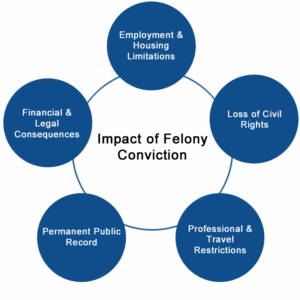 How a Felony Conviction Can Harm You
A conviction of felony OWI stays on your record forever, permanently altering your future, limiting your rights to vote or own a firearm, and limiting your ability to find employment or housing. This conviction will be part of the public record, visible to potential employers, landlords or professional licensing boards. The only way to protect yourself from this lifelong albatross around your neck and protect your freedom is to seek out an experienced attorney.
With their expertise at your service, you can avoid a conviction and the subsequent impacts to your employment, firearm rights, professional licensure, immigration status, travel eligibility, financial security and reputation in the community. If you are facing felony OWI due to prior convictions or extenuating circumstances, you need someone who can help you challenge the evidence against you, build on a strategy and navigate the tricky litigation you face.
A public defender or a discount attorney can represent you, but only an experienced attorney can provide you with the protection you need to secure your civil rights and your future. A public defender often doesn’t have the resources or the time to devote their full attention to each detail of your case. A discount attorney is far more likely to push you toward a plea deal that saddles you with a permanent felony conviction. But an experienced attorney will do more, because they understand what’s at stake.
With a felony OWI conviction, you could face years in prison, tens of thousands in fines, loss of driving privileges, and a lifetime of consequences. That’s why an experienced OWI defense attorney will work harder to find the weaknesses in the cases against you that others might miss. They’ll expand on the strategies outlined above, attacking inconsistencies in evidence, procedural mistakes on the part of law enforcement, or legal issues with evidence to kneecap the prosecution’s case.
Don’t take a chance on representation when your future is on the line. Make the investment in representation that will protect your future with skill, precision and exhaustive preparation to preserve your rights. Before you talk to prosecutors or make a decision that you’ll live with forever, call us to schedule a free consultation with one of our experienced attorneys. During this 30- to 60-minute meeting, you’ll gain a better understanding of your case and the strategies that will work for you, and walk away with peace of mind and a plan to protect your future. Submit your contact information below to schedule your no-obligation consultation.
Featured in The Media




Call 1-888-597-3622 or Schedule a Free Case Evaluation Online
Contact Us
Footer
Locations
Headquarters, Main Office, and Mailing Address
Tracey Wood & Associates
6605 University Avenue
Suite 101
Middleton, WI 53562
Downtown Office

Tracey Wood & Associates
345 West Washington Avenue
Suite 328
Madison, WI 53703
Tracey Wood & Associates
6605 University Avenue
Suite 101
Middleton, WI 53562
Downtown Office
Tracey Wood & Associates
345 West Washington Avenue
Suite 328
Madison, WI 53703