
Most Cases are Reduced or Dismissed: We are proud of our record with our clients. You deserve an attorney who can help prevent you from acquiring a criminal record.
Award Winning Book Author

Tracey Wood is a widely respected resource for criminal and OWI-related defense. As an author and attorney, her work is frequently cited by other defense attorneys, prosecutors, and even judges.

We Empower & Educate You – At No Cost

We take pride in educating any potential clients through our free case assessments. Even if you choose not to hire us, you will have a better outlook on your case after meeting with us.

OWI Second Offense Wisconsin

Classification

The difference between a misdemeanor and a felony matters because it affects nearly every part of your life. A misdemeanor is still serious, but it is generally more limited in its long-term impact. A felony, on the other hand, can follow you for life. It can affect your ability to get a job, find housing, obtain professional licenses, and even impact your civil rights. In short, the classification of the charge can shape your future long after the case is over.

A second-offense OWI in Wisconsin is usually charged as a misdemeanor criminal offense. Unlike a first offense, which is typically a civil violation, a second offense automatically brings criminal penalties. However, the charge can become a felony if certain aggravating factors are present, such as causing an injury, great bodily harm, or death. When that happens, the consequences become much more serious and can have long-term effects on your record and your future.

A Second Offense is a Permanent Criminal Record

If you are convicted, it creates a permanent criminal record that cannot be erased or expunged or sealed under Wisconsin law. In other words, it stays with you for life.

Worst Case Scenario Versus Best Case Scenario

A conviction for a second-offense OWI in Wisconsin means you are found guilty and face mandatory penalties like jail time, fines, license revocation, and a permanent criminal record. An acquittal means you are found not guilty, so there are no fines, no jail time, no permanent record from that charge, and it is as if the case never happened.

Getting an attorney involved early can completely change the direction of a second OWI case. If you do nothing, the State will move forward assuming your record is correct and that you qualify for harsher, criminal penalties. That usually leads to a much worse outcome.

Here’s what most people don’t realize: a “second offense” is not always truly a second offense under the law.

In Wisconsin, if your first OWI happened more than ten years before your new arrest, your case can be treated like a first offense again. That means no criminal charge and no jail time. This ten-year rule is strict and is based on the date of your first conviction compared to the date of the new arrest. Even being just outside that window can completely change your situation.

And just because the State says it falls within ten years does not mean they are right. That can be challenged.

The same goes for out-of-state priors. These are often counted incorrectly. If the records are inaccurate, or if the other state’s law does not match Wisconsin’s OWI law, that prior may not count at all.

If any of these challenges work, the impact is major. Your case can be reduced from a criminal second offense to a civil first offense. That means no jail, lower fines, and a much less serious situation overall.

Even if those options do not apply, there may still be another path. A more advanced legal strategy called a collateral attack can sometimes be used to prevent your first OWI from being used against you.

A collateral attack is not an appeal of your old case. Instead, it challenges whether that first conviction should count at all in your current case. The prosecutor is relying on that prior to increase the penalties. If a judge decides that conviction was legally invalid, it cannot be used to enhance your new charge.

These challenges are limited and must be based on a violation of your rights in the first case. For example, if you were not properly informed of your right to an attorney, did not validly give up that right, or were not properly advised before entering a plea, the prior may be invalid. What will not work are arguments that the evidence was weak or that the judge made a bad decision.

While not available in every case, a successful collateral attack can be powerful. It can strip away the “second offense” label, reduce the penalties you are facing, and give you a much stronger chance at protecting your record and your future.  Please read more below about this topic.

What Must be Proven

To convict you of a second-offense OWI in Wisconsin, the State has to prove several things beyond a reasonable doubt. First, they must show that you were operating a motor vehicle while under the influence of an intoxicant or that your alcohol concentration was at or above the legal limit, usually 0.08% or higher.

Second, because this is a criminal charge, they must prove that you have a prior qualifying OWI conviction or refusal within the last 10 years. This is what elevates the case from a civil matter to a criminal offense.

Finally, the State has to show that all of the evidence they are relying on, including any tests, was obtained lawfully. That means the traffic stop, the investigation, and the arrest all must comply with constitutional requirements. Because there are so many steps involved and so many tests conducted by different people, there is room for error. This can lead to innocent people being accused of crimes. It can also mean that many innocent people can challenge the litany of tests (police investigation, breath test, field sobriety tests, and blood tests) and end up with their case dismissed, reduced, or acquitted in a court of law.

Saving Your Driving Privilege – Notice of Intent to Suspend Your License

The most critical thing you can do after a second-offense OWI is save your ability to drive and provide for yourself so you don’t jeopardize your job.

After a DUI (OWI) arrest in Wisconsin for a second offense, you’ll receive a notice that your license is going to be suspended. But you’re not cut off immediately. In most cases, you can still drive for about 30 days.

Here’s what most people miss: you only have 10 days to request an administrative review hearing to challenge that suspension. If you do nothing, your license will automatically be suspended on day 31. No second chances.

This hearing is completely separate from your criminal case. Think of it as a second track running at the same time. The criminal case decides whether you are convicted, but this administrative process decides what happens to your license right now.

At the hearing, the focus is narrow:
• Was the traffic stop legal?
• Did the officer have a valid reason to arrest you?
• Were the tests done properly?

This is where things get powerful.

The hearing is not just about your license. It gives your defense attorney an early opportunity to question the officer under oath, lock in their story, and uncover weaknesses before the criminal case even begins.

What happens next depends on your situation:

If you took the test and were over 0.08%
You are typically facing about a 6-month suspension, but you may be eligible for an occupational license right away, allowing you to drive for work, school, and essential needs.

If you refused the test
The penalties are significantly harsher. You are facing about a 1-year revocation, along with a waiting period before you can even apply for limited driving privileges.

Hypothetical 1: Winning the Hearing and Taking Control of the Case

John is arrested for a second OWI. He acts quickly and requests the hearing within the 10-day window.

At the hearing, his attorney challenges the reason for the traffic stop. The officer struggles to clearly explain why John was pulled over, and the testimony becomes inconsistent.

The examiner rules in John’s favor. His license is not suspended, and he keeps his full driving privileges with no restrictions.

But the real advantage comes next.

Because the officer’s testimony is now locked in, John’s attorney uses it in the criminal case. About a month later, the court determines the stop was unjustified. Without a lawful stop, the evidence is suppressed.

The result: the case is dismissed.

John not only keeps his license, he avoids a conviction entirely because he acted within those first 10 days.

Hypothetical 2: Missing the Hearing and Limiting Your Options

Mike is also arrested for a second OWI, but he does not request the hearing within 10 days. On day 31, his license is automatically suspended.

Now he is forced into damage control.

Because he needs to work, Mike applies for an occupational license. He is able to drive, but only under strict conditions:

• Limited hours
• Restricted routes
• Specific purposes like work or school
• Mandatory ignition interlock device on every vehicle he operates

Mike can still function day to day, but his freedom is restricted.

More importantly, he lost something most people never realize they had:

The chance to challenge the suspension early.
The chance to lock in the officer’s testimony.
The chance to create leverage that could have changed the outcome of his entire case.

In a second OWI case, those first 10 days are not just about your license. They can shape the direction of your defense and, in some cases, determine whether the case can be challenged at its foundation.

The Clock is Ticking

The timeline starts immediately, whether the notice is handed to you or mailed, and your request must be postmarked within 10 or 13 business days depending on how you received it. What matters is the postmark date, not when you write or send the request, and missing that window usually means losing the chance to challenge the suspension. At the same time, the hearing must occur within 30 days of the notice date, because the suspension automatically begins at 12:01 a.m. on the 31st day.

Occupational License with the Huber Release

Your driver’s license will be revoked for 12 to 18 months or longer. Once that time is up, you will be required to install an Ignition Interlock Device (IID) on every vehicle you own or drive. While the IID is in place, you must stay completely sober every time you drive.

Refusing a breath or blood test on a second OWI within ten years of the first makes the situation even more serious. A refusal leads to a two-year license revocation, a mandatory IID, and a 90-day waiting period before you can apply for an occupational license. The refusal can also be used as evidence against you in court.

The bottom line is that a second OWI comes with long-lasting consequences that go far beyond fines or jail. However, an arrest is not the same as a conviction. There are many legal defenses that can be used to challenge the case, and in some situations the charges can be reduced or dismissed altogether.

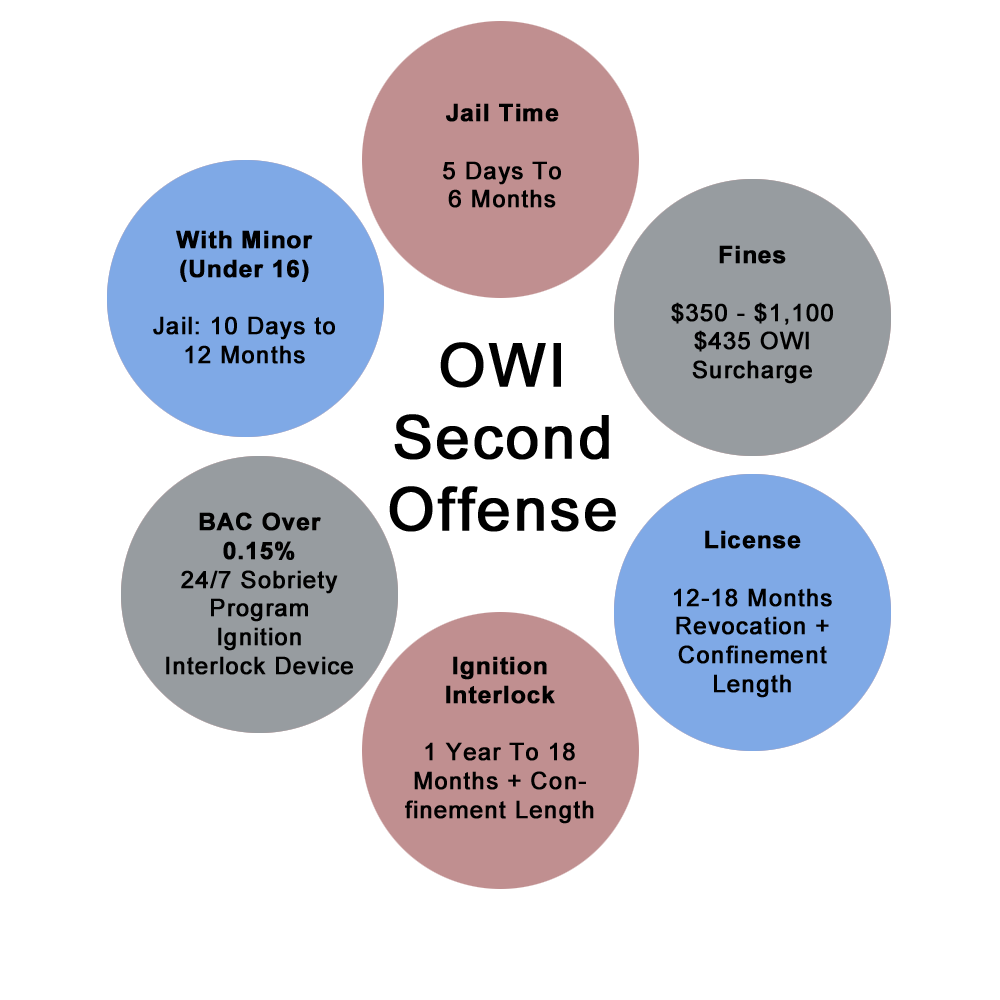
A second OWI conviction in Wisconsin carries serious and mandatory consequences. If convicted, you face a required jail sentence ranging from a minimum of five days up to six months. In many cases, courts may allow Huber release, which lets you leave jail for work, but this depends on the county and requires verification from your employer. Your driver’s license will be revoked for 12 to 18 months, and that period can be extended based on the length of your jail sentence. Immediately after conviction, there is a strict 45-day period where you are not allowed to drive at all. After those 45 days, you may be eligible to apply for an occupational license, but only if you install an ignition interlock device (IID) in your vehicle and obtain SR-22 insurance. Financially, you can expect fines ranging from $350 to $1,100, though the total cost will be higher once court fees are included. Additionally, you will be required to complete an Alcohol and Other Drug Assessment (AODA) and follow through with any recommended treatment.

These defense strategies can include questioning the reason for the traffic stop, challenging the accuracy of breath or blood test results, and pointing out problems with field sobriety tests. In some cases, medical conditions that mimic signs of intoxication or health issues that can cause inaccurate test results may also be used as part of the defense.

In addition to these approaches, there are legal tactics specific to Wisconsin, such as using the look-back period to challenge how a prior conviction is counted, or filing a collateral attack to argue that a past conviction should not be used under certain circumstances.

Below is a summary of the potential consequences of this charge, along with strategies you can use to work toward the best possible outcome for your situation.

Why Collateral Attacks Matter So Much for Second Offense OWI Charges in Wisconsin

A collateral attack in a Wisconsin second-offense OWI is a focused legal strategy your attorney can use to stop your prior case from making your current situation worse. A second offense is treated as a criminal charge because the court relies on your first OWI to increase the penalties. A collateral attack is your attorney stepping in and saying that the first case should not be used here.

This is not a full redo of the first case. It usually comes down to one key issue, which is your right to a lawyer. Your attorney is trying to show that you did not have a lawyer in your first case and were not properly informed of your right to one, or that you did not clearly give up that right. If that can be proven, the court cannot use that first OWI to enhance the penalties in your current case.

If the collateral attack is successful, it can completely change the direction of your case. Instead of being treated as a second offense, your case may be treated like a first offense. That can mean avoiding mandatory jail time, reducing fines, and keeping the case as a non-criminal traffic matter instead of a criminal charge.

It is important to understand that this does not erase your first OWI from your record. The conviction still exists and still counts for things like your driving history. What it does do is prevent that prior case from being used against you right now to increase the stakes. In simple terms, it is not about fixing the past, it is about protecting your future.

Jake was charged with a second offense OWI, which meant he was facing a criminal charge with mandatory jail time and an ignition interlock device. His attorney, Tracey Wood, identified that Jake did not have legal representation in the prior OWI case and filed a collateral attack to challenge its use in enhancing the current charge. After exposing this issue, the prosecutor agreed to reduce the case to a first offense OWI. This result eliminated the mandatory jail sentence, avoided the ignition interlock requirement, and shifted the case from a criminal charge to a non-criminal traffic offense, significantly reducing the overall impact on Jake’s life. As a first offense, Jake was now looking at a civil matter rather than a crime, which meant no criminal record, no jail exposure, lower fines, and more manageable penalties overall. It also protected his future, keeping his record cleaner for employment, housing, and background checks, while giving him the opportunity to move forward without the long-term consequences that come with a criminal conviction.

Reducing a Second Offense OWI to Reckless Driving

A second-offense OWI in Wisconsin can potentially be reduced to reckless driving if the prosecutor believes there are real weaknesses in the case. By law, they cannot reduce the charge unless there is a valid legal or evidentiary issue. These weaknesses often involve problems with the traffic stop, field sobriety tests, chemical testing, or inconsistencies in the police reports. If those issues create enough doubt, the prosecutor may request a reduction, but the judge must approve it. The value of that reduction is significant because it can remove mandatory jail exposure, reduce fines and long-term costs, and help avoid the harsher criminal penalties and lasting consequences that come with a second OWI conviction.

Most Common Strategies to Beat a Second Offense OWI in Wisconsin

The process of beating an OWI charge in Wisconsin often starts with filing motions to suppress evidence. This is where your defense attorney asks the court to throw out evidence that was obtained improperly or in violation of your rights. If key evidence is suppressed, the State’s case can begin to fall apart before it even reaches trial.

From there, the strategy becomes simple but relentless: challenge everything. Every step the police officer took, every procedure they followed, and every piece of evidence they collected is placed under a microscope. Even the smallest mistake can create a crack in the case. And that crack can grow into an opportunity to have the OWI dismissed, reduced, or acquitted, what we call the best possible outcome.

This includes challenging whether the officer had reasonable suspicion to stop you in the first place, and whether there was probable cause to arrest you. It means questioning how the field sobriety tests were administered, whether the breath test was reliable, and whether the blood test was handled and analyzed correctly. It also involves exploring whether medical conditions or other factors could explain the signs of impairment.

If those challenges do not immediately resolve the case, the work does not stop. This is where a deeper, more strategic approach comes into play, digging into the nuances, inconsistencies, and overlooked details that can shift the direction of the case.

The goal is straightforward: to be more prepared than the officer who arrested you and the prosecution trying to build a case against you. There are countless ways to challenge an OWI, and the right defense is about finding the one that works in your favor, using it effectively, and moving step by step toward a life without a conviction or permanent record, even in a second-offense case.

Standard Consequences for a Second Offense OWI Conviction in Wisconsin

Jail Time

For a second OWI in Wisconsin, jail is usually part of the deal if you’re convicted. A judge can’t just take it off the table. The law says you have to serve at least 5 days in county jail, and it can go all the way up to 6 months depending on what happened in your case. Every situation is different, but the bottom line is this: if there’s a conviction, some form of custody is required.

That said, it doesn’t always mean sitting in a jail cell the entire time. Some people qualify for Huber release, which lets you leave jail for things like work, school, or other approved responsibilities. Others may be able to serve their time on electronic monitoring, which is basically house arrest instead of being physically in jail.

There are also ways to potentially reduce or even avoid actual jail time. Some counties offer programs like Safe Streets, where treatment can replace or shorten time behind bars if you complete it successfully. And in certain cases, an attorney can challenge your prior OWI through what’s called a collateral attack. If that works, your current case could be treated like a first offense instead of a second, which can eliminate the mandatory jail requirement.

But the most powerful alternative to any of this is fighting the case itself. If your attorney can get the case dismissed, reduced, or win a not guilty verdict, then there is no jail, no house arrest, and no sentence at all. A not guilty result is always the best outcome, because it avoids the consequences completely instead of just changing how you serve them.

Pretrial Release Conditions

When someone is charged with a second OWI in Wisconsin, the system begins to look at the situation differently. It is no longer treated as a one-time mistake. Instead, it starts to look like a pattern that could continue if nothing changes. Because of that, the court does not rely on hope or promises. It puts structure in place to control the situation while the case is pending.

This shift happens because a second offense raises a bigger concern. A first OWI is often seen as a lapse in judgment. A second one suggests the earlier consequences, like fines or losing a license, were not enough to stop the behavior. From the court’s perspective, that creates a higher risk that it could happen again.

Judges are also looking at something deeper. A second offense can signal a possible substance use issue, not just a one-time decision. Because of that, courts often approach these cases with the idea of managing behavior and addressing underlying alcohol use, even before the case is resolved.

There is also a broader concern in the background. If someone is released without conditions and something serious happens, like another crash, it reflects on the system that allowed it. Because of that, judges tend to act cautiously and put safeguards in place, not just for the person charged, but for everyone else on the road.

That is where the pretrial conditions come in. They are not random, and they are not meant just to make things harder. Each one is designed to address the underlying issue in a practical way.

If alcohol played a role in the arrest, the court often requires complete abstinence. The idea is simple. Remove the thing that led to the situation in the first place. Random testing supports that by replacing trust with proof, so there is no question about compliance. Regular check ins create accountability. Knowing you have to report and stay on track each week makes it much harder to fall back into old habits.

Taken together, these conditions are less about punishment and more about control. The goal is to keep things stable, reduce risk, and prevent the situation from getting worse while the case moves forward.

License Revocation/Suspension

Occupational License (45-Day Wait)
There is a 45-day waiting period before you can apply for an occupational license after a second OWI conviction. However, if you have two OWI-related incidents (including convictions or refusals) within a 5-year period, this waiting period increases to 1 year.

Administrative Suspension
Separate from the court case, there is an automatic 6-month administrative suspension if you fail a chemical test (.08 BAC or higher). This happens regardless of whether you are ultimately convicted, meaning it runs on a parallel track alongside your criminal case. You have only 10 days from the date of the notice to request a hearing to challenge this suspension.

Ignition Interlock Device (IID) & BAC Limits
An IID is mandatory for all second-offense convictions, regardless of your BAC level. While a BAC of .15 or higher triggers the IID requirement for first-time offenders, it is an automatic requirement for any second offense. Once an IID is ordered, your legal driving limit is reduced to .02 BAC. Exceeding this limit can result in the IID requirement being extended by 6 months.

Refusal of a Test
Refusing a breath, blood, or urine test triggers a separate penalty under Wisconsin’s implied consent law. For a second offense, or a refusal with one prior OWI, this results in a 2-year license revocation. The waiting period for an occupational license after a refusal is typically 90 days, but if you have two OWI-related incidents within a 5-year period, that waiting period increases to 1 year.

Minor Passenger (Under 16)
If a minor under the age of 16 is in the vehicle at the time of the offense, the penalties increase significantly. The minimum and maximum fines and jail time are doubled. In addition, the license revocation period also doubles, meaning the standard 12 to 18 months increases to 24 to 36 months. The IID requirement is also mandatory and typically doubles in duration.

In many cases, courts may allow Huber release, which lets you leave jail for work, but this depends on the county and requires verification from your employer. Your driver’s license will be revoked for 12 to 18 months, and that period can be extended based on the length of your jail sentence. Immediately after conviction, there is a strict 45-day period where you are not allowed to drive at all. After those 45 days, you may be eligible to apply for an occupational license, but only if you install an ignition interlock device (IID) in your vehicle and obtain SR-22 insurance. Additionally, you will be required to complete an Alcohol and Other Drug Assessment (AODA) and follow through with any recommended treatment.

Huber release, also known as work release, allows someone serving a jail sentence for a second OWI in Wisconsin to leave jail for limited, approved purposes such as work, school, treatment, or other essential responsibilities, while still serving their sentence. Its value comes from the ability to maintain stability during a difficult time. Instead of being fully confined and risking the loss of a job, income, or family support, Huber release allows a person to continue working, meet financial obligations, and stay connected to daily responsibilities. This can prevent long-term damage to a person’s career and personal life, while also allowing them to complete required programs like alcohol assessments or treatment.

To qualify for Huber release, it must first be approved by the judge and then accepted by the jail or sheriff’s department, as it is not automatic. You typically need to show proof of employment or another approved purpose, provide a structured schedule, and comply with all court-ordered conditions. This often includes completing an Alcohol and Other Drug Assessment (AODA), following any recommended treatment or Driver Safety Plan, complying with Ignition Interlock Device (IID) requirements if ordered, and paying fines or fees. You must strictly follow the rules of release, which usually means traveling directly to and from approved locations and returning to jail on time. Any violations can result in the immediate loss of Huber privileges.

In practical terms, Huber release turns a mandatory jail sentence from something that can completely disrupt a person’s life into something far more manageable, allowing them to serve their time while still preserving their job, responsibilities, and overall stability.

Fines and Mandatory Surcharges

In Wisconsin, a second OWI conviction carries a mandatory base fine between $350 and $1,100, which can escalate significantly based on high BAC levels.

The mandatory OWI surcharge has increased to $535 and is used specifically to fund sobriety enforcement tools like breathalyzers and lab testing.

Judges have no legal authority to waive these surcharges or drop the fine below the statutory minimum, meaning these costs can only be avoided if the charge is dismissed or amended

Ignition Interlock Device (IID)

An ignition interlock device is a breath-testing machine that is installed in a vehicle.

Before the car will start, the driver has to blow into the device. If alcohol is detected, the car will not start. While driving, the device will also require random retests to make sure the driver stays sober. Most devices also include a camera to confirm who is providing the breath sample.

This exists for one main reason: public safety. After a second offense, the state no longer relies on trust. Instead, it uses technology to physically stop someone from driving if they have been drinking.

This is mandatory in a second offense case. If someone wants to drive again legally, they must install and use the device. Even if they do not currently own a vehicle, the order still applies to any vehicle titled or registered in their name.

There is no way to opt out of this requirement.  That is, unless you request an administrative review hearing.

Mandatory Alcohol and Other Drug Assessment (AODA)

Wisconsin’s second-offense protocols mandate a clinical evaluation to categorize a person’s relationship with substances and establish a binding framework for rehabilitation. This evaluation dictates the specific requirements of a Driver Safety Plan, which often includes intensive classroom education or long-term therapeutic treatment. Maintaining strict compliance with these professional recommendations is the only path toward satisfying court requirements and eventually regaining legal driving privileges.

Community Service

Under Wis. Stat. § 346.65, a judge in Wisconsin has the option to allow someone facing a second-offense OWI to complete community service in place of some penalties. In certain cases, those hours can be used to reduce fines at a set rate or, depending on the situation, take the place of some or all of the required jail time.

This type of work is usually done through nonprofits or public agencies that focus on community impact. However, it is not guaranteed. Whether it is offered depends on the county and the judge handling the case.

To move forward with this option, the court must issue a written order, and the organization receiving the service must agree to accept the individual under those terms.

Victim Impact Panel

For a second-offense OWI in Wisconsin, a Victim Impact Panel (VIP) is typically a required part of the Driver Safety Plan after your assessment. Instead of lectures, these sessions focus on real-life stories from victims, families, and first responders to show the true impact of impaired driving and promote accountability.

Attendance is mandatory to maintain or regain your driving privileges, and missing it can lead to non-compliance with the Department of Transportation. Most panels last 1 to 2 hours, cost between about $20 and $100+, and require strict rules like pre-registration, valid ID, and complete sobriety, sometimes verified by a breath test.

After completing the panel, you receive a certificate that must be submitted to the court or assessment agency.

Enhancements & Aggravating Factors

High BAC Multipliers (The “Tiers”)

Wisconsin does not treat every second offense OWI the same. As your blood alcohol concentration (BAC) rises, the court begins to view the situation less as a mistake and more as a serious safety risk. That shift in perception is what drives the “multiplier effect.”

At a BAC between .17 and .199, the penalties are doubled. This means you are still within the same statutory jail range of 5 days to 6 months or more, but judges often increase the minimum time actually served. In many counties, that means 10 days or more becomes the realistic starting point. Fines also increase significantly, ranging from $700 to $2,200 or more.

As the BAC climbs to between .20 and .249, the court sees an even higher level of impairment. At this level, the fines are tripled, reaching $1,050 to $3,300 or more, and judges frequently push minimum jail sentences into the 15-day range or higher. The higher the number, the harder it becomes to argue that the situation was a one-time lapse in judgment.

At .25 or higher, you are in the most severe tier. Fines are quadrupled, reaching $1,400 to $4,400 or more, and many judges treat this level as extreme intoxication. In practice, that often leads to 20 days or more in jail, even though the statute still lists 5 days to 6 months. At this point, the court is not just punishing the act. It is trying to prevent what it sees as a significant risk of future harm.

Minor in the Vehicle (Under 16)

When a child under 16 is in the vehicle, the entire case takes on a different tone. The court is no longer just looking at your conduct. It is looking at the risk created for someone who cannot protect themselves.

Because of that, the penalties are automatically doubled. Jail exposure increases to 10 days up to 1 year or more, and fines range from $700 to $2,200 or more, plus surcharges. But the impact goes beyond just the numbers.

Judges often view these cases through the lens of protection and accountability. That can lead to stricter probation conditions, more intensive monitoring, and a stronger push toward alcohol-related assessments or treatment. In other words, the system starts asking not just “what happened,” but “how do we make sure this never happens again.”

Injury or Death (The Felony Shift)

If the case involves injury or death, everything changes. What started as a misdemeanor second offense OWI becomes a felony, and the consequences expand dramatically.

If someone is injured and there is a prior OWI, the charge becomes a Class H felony. This carries up to 6 years in prison or more, along with fines up to $10,000 or more when surcharges and costs are included. At this level, the focus shifts toward long-term consequences, including prison exposure, extended supervision, and a permanent felony record.

If the injury rises to great bodily harm, meaning there is a serious risk of death or permanent damage, the charge escalates to a Class F felony. Now the exposure increases to up to 12.5 years in prison or more, with fines up to $25,000 or more. The case is no longer about impairment alone. It becomes about the severity of the harm caused.

If the case involves death, the charge becomes a Class C felony. This carries up to 40 years in prison or more and fines up to $100,000 or more. At this level, the system is focused on punishment, accountability, and the lasting impact of the loss of life.

How to Appeal a Second Offense OWI in Wisconsin

To appeal a second offense OWI in Wisconsin, you must first file a Notice of Intent to Pursue Postconviction Relief within 20 days after sentencing. After that, you either file postconviction motions in the trial court or move forward with a formal appeal in the appellate court.

An appeal is not about simply disagreeing with the outcome. It must be based on specific legal errors, such as an unlawful traffic stop, improper admission of evidence, or violations of your constitutional rights.

The process involves creating a formal record of what happened in the case, including transcripts, and submitting written legal arguments called briefs. If the appeal is successful, the court may reverse the conviction, reduce the sentence, or send the case back for a new trial.

The High Stakes of a Second Offense OWI

When you are facing a second offense OWI, the margin for error becomes very small. The decisions you make in the days after your arrest can shape your future in a real and lasting way. You are at a turning point. You can accept the consequences that come with a conviction, or you can take action and fight to protect your ability to work, drive, and move forward.

Investing in a strong defense is not just about getting through your next court date. It is about protecting your record, your freedom, and your long term opportunities. Investing in your future self today can be the difference between moving forward clean or carrying a conviction that follows you for years.

Winning often comes down to preparation. The side with the strongest command of the facts, the evidence, and the law is the side most likely to prevail.

Why Preparation and Experience Matter

A second OWI is not the time to rely on inexperience. The State is already building its case step by step. To counter that, your defense must be more thorough, more strategic, and more prepared.

At the core of a strong defense are a few key principles:

Knowledge is power
The attorney who is more prepared, understands the evidence in greater detail, and has a stronger connection to the client holds the advantage in the courtroom.

Trial ready from day one
Every case is approached as if it will go to trial. This level of preparation allows your defense to anticipate what the prosecution will do next and respond from a position of strength, not reaction.

Independent investigation
Police reports are not taken at face value. A proper defense looks deeper by reviewing body camera and dash camera footage, interviewing witnesses, and examining every step of the investigation to uncover errors or inconsistencies.

Command of the details
By the time your case reaches court, the goal is to understand it better than anyone else involved. That includes knowing the evidence, identifying weaknesses in the prosecution’s case, and understanding how the judge approaches these types of cases.

When these principles are applied, even small mistakes in the State’s case can become meaningful opportunities. Those opportunities can lead to a dismissal, a reduction, or a not guilty verdict.

Example OWI Second Offense Case Wins

Tracey Wood & Associates has a proven track record of winning cases that initially appear unwinnable. Below are several examples of successful outcomes in second-offense OWI cases.

Second-Offense OWI Reduced Through Collateral Attack

A client was stopped at night while on their way home after being out at dinner with friends and was initially charged with a second-offense OWI based on a prior conviction.

The defense challenged the validity of that prior conviction by filing a collateral attack, identifying multiple issues that showed the client had not been properly defended in the earlier case.

After reviewing the challenge, the prosecutor agreed and reduced the charge from a second offense to a first offense.

This result protected the client from the significantly harsher penalties tied to a second offense.

Second-Offense OWI Dismissed After Invalid Stop Challenge

The client was charged with a second-offense OWI after being stopped at night while returning home. The defense challenged the legality of the traffic stop, arguing that the police officer did not have a valid legal basis to initiate it.

A motion to suppress was filed to exclude all evidence obtained from the stop. The court agreed that the stop was unlawful and granted the motion, suppressing the evidence.

Without admissible evidence, the State could not move forward, and the second-offense OWI charge was dismissed.

Read additional example case wins.

FAQS

Can a Second Offense OWI Be Dropped in Wisconsin?

It is possible, but it requires a significant amount of work from an experienced OWI defense attorney.

Wisconsin Statute 967.055 mandates that the State “vigorously” prosecute anyone accused of operating while intoxicated by drugs or alcohol. Unlike many other states, where prosecutors have broad discretion to reduce or dismiss charges on their own, Wisconsin law removes that flexibility in OWI cases.

In Wisconsin, a prosecutor cannot simply decide to drop or reduce an OWI charge. Any change must be presented to and approved by a judge, who must determine that the decision serves the public interest. This added layer of oversight is designed to ensure consistency, accountability, and transparency in how OWI cases are handled.

In practical terms, this means that getting a second-offense OWI dropped is not about negotiation alone. It requires a strong, strategic defense that exposes weaknesses in the State’s case and gives the judge a clear legal basis to approve a dismissal or reduction.

Is a Second OWI a Criminal Offense?

Yes, a second OWI is a criminal misdemeanor, meaning it is prosecuted as a crime, not a traffic violation, and carries real jail time, a permanent criminal record, and full criminal court proceedings.

Schedule a Free Case Evaluation

A second-offense OWI is a life-altering event, not a minor setback. Unlike a first offense, a second OWI is a criminal prosecution that can leave you with a permanent record and consequences that follow you for years. If you cannot afford the fallout of a conviction, you need to act now.

Take Control of Your Defense

Schedule a free legal consultation to move from uncertainty to action. This is your opportunity to get clear answers, understand your options, and begin challenging the case against you. During this consultation, the defense team at Tracey Wood & Associates will:

  • • Identify critical weaknesses in the prosecution’s evidence
  • • Begin collecting evidence and securing time-sensitive information, such as dashcam footage or blood-draw logs
  • • Develop an initial strategy aimed at protecting your freedom, your license, and your future

The 10-Day Clock Is Ticking

Your driving privileges may already be in jeopardy. You have only 10 days from the date of your arrest to challenge the administrative suspension of your license. Missing this deadline can result in the automatic loss of your right to drive.

Do not leave your future to chance. Submit your information below to schedule your consultation online, over the phone, or in person. Consultations typically last about an hour, everything shared is 100% confidential, and there is no cost or obligation to hire our firm.

Featured in The Media

Call 1-888-597-3622 or Schedule a Free Case Evaluation Online

Contact Us

  • This field is for validation purposes and should be left unchanged.

Scroll Back to Top
24-Hour Support